

Last Updated: November 8, 2026
Quick Summary
Most residential HVAC installation takes four to eight hours of on-site work for a straightforward replacement, according to Trane’s residential installation guidance. The full project, from first call to cool air, usually stretches across several days or weeks once you count quoting, permits, equipment ordering, and inspections.
- A full system swap, meaning AC plus furnace or air handler, runs one to two days on site.
- Installing central air with existing ductwork in good condition usually takes one workday.
- Removal and disposal of old equipment typically takes one to three hours.
- Setting the new indoor and outdoor units is the core of the job, taking three to five hours.
- Ask your contractor for both timelines up front: on-site hours and total calendar time.
Table of Contents
- HVAC Installation Time at a Glance
- What the HVAC Installation Process Involves
- How Long Does It Take to Install Central Air With Existing Ductwork?
- AC, Heat Pump, and Full HVAC Replacement Timeline by System Type
- Factors That Affect Installation Duration
- Your HVAC Installation Day Checklist
- Pre-Installation Steps That Can Delay Your Start Date
- Schedule Your Installation With Barber Plumbing & Heating
- Frequently Asked Questions
HVAC Installation Time at a Glance
Most residential HVAC installations take between four and eight hours of on-site work for a straightforward replacement, according to Trane’s residential installation guidance. That number only covers the crew’s time in your home. The full HVAC installation project, from first call to cool air, usually stretches across several days or weeks.
That gap between “a day” and “a month” trips up a lot of homeowners. The crew works fast once they arrive, but scheduling, permits, equipment delivery, and inspections all sit on the calendar before and after.
Below, we break down the HVAC installation process phase by phase, showing which jobs fit in one day, which run longer, and how to keep your start date from slipping.
On-Site Hours vs. Total Project Calendar Time
Two clocks run during any installation. The first is the crew’s time in your home. The second is the calendar time from your first call to your first cool evening.
| Clock | Typical Range | What It Covers |
|---|---|---|
| On-site labor | One workday for most replacements | Old unit removal, new unit set, connections, testing |
| Full system swap | One to two days on site | AC plus furnace or air handler replacement |
| Total project calendar | Several days to a few weeks | Quote, scheduling, equipment order, inspection |
A common mistake is planning around the on-site number alone. A missing permit or a backordered condenser will wreck a Thursday booking. Ask your contractor for both timelines up front.
What the HVAC Installation Process Involves
The HVAC installation process follows the same basic arc on nearly every job: remove the old equipment, set the new indoor and outdoor units, then connect and test everything. What changes is how much extra work each phase demands. Most guides stop at a total-hour estimate; the phase-by-phase schedule below is the part they leave out.
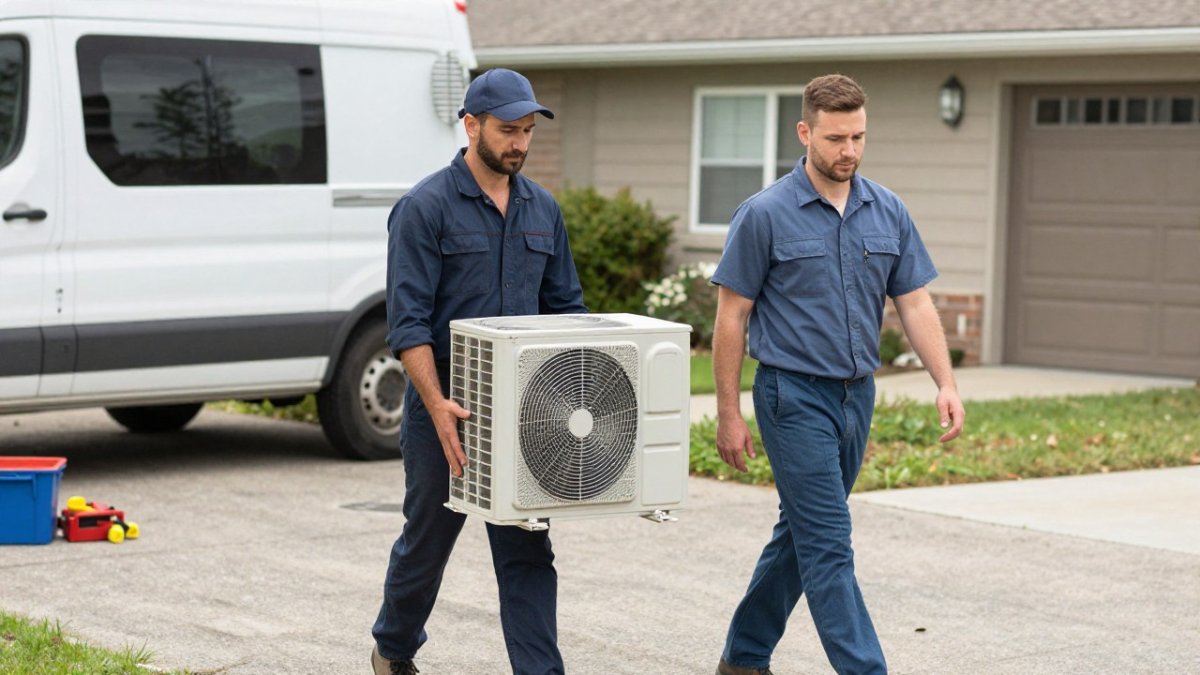
Here is how the phases stack up on a typical one-day replacement, with the ranges most crews work within.
Phase 1: Removal and Disposal of Old Equipment (1-3 hours)
Old unit removal sounds simple, but it can be more involved than it looks. Removal typically means disconnecting power, recovering refrigerant, and hauling out equipment that may be heavy and awkward to reach.
This phase can take a meaningful part of the day on a standard replacement. It stretches when:
- The old outdoor unit sits behind a fence, on a roof, or in a tight side yard
- The indoor coil or air handler lives in a cramped attic or crawlspace with limited headroom
- Old refrigerant lines are damaged, kinked, or sized for R-22 and need replacing for the new R-410A or R-454B system
- The old unit is a packaged system that has to come out in one piece
Ask about disposal, too, responsible removal means proper refrigerant handling and scrap disposal, not a quick dump.
Phase 2: Indoor and Outdoor Unit Installation (3-5 hours)
Setting the new equipment is the core of the job. The outdoor unit needs a level pad with clear airflow, and the indoor unit needs to fit the space and connect cleanly to the ductwork and drain line.
Phase 3: Connections, System Testing, and Commissioning (1-2 hours)
Commissioning is an important phase of the installation, and it is the phase most homeowners never see. It includes connecting wiring and refrigerant lines, checking for leaks, and charging the system to the manufacturer’s specifications.
Then comes the test run, during which the system is checked for proper operation before the crew leaves.
Ask your contractor what they check before they leave.
On-site time by HVAC installation phase
How Long Does It Take to Install Central Air With Existing Ductwork?
Installing central air with existing ductwork in good condition usually takes one workday. The ductwork is already in place, so the crew focuses on the outdoor condenser, indoor coil, refrigerant lines, and thermostat.
Duct condition decides whether that estimate holds. Crushed flex duct, heavy leaks, or undersized returns must be fixed first, which can add hours and sometimes push the job into a second day.
Here is how to tell which version you are getting:
- Good ductwork: sealed joints, proper sizing, no visible tears. Expect a one-day install.
- Fair ductwork: minor leaks or a few crushed runs. Expect a longer day or a small added scope.
- Poor ductwork: major leaks, undersized ducts, or asbestos-era materials. Expect a second visit.
Ask for a duct inspection during the quote. It is the single best way to predict your real install day.
AC, Heat Pump, and Full HVAC Replacement Timeline by System Type
Different system types carry different timelines. A like-for-like AC replacement is the fastest job on the board. A full HVAC replacement, meaning both heating and cooling equipment, takes longer because there is more to remove, set, and connect.
| System Type | Typical On-Site Time | What Adds Time |
|---|---|---|
| AC replacement, existing ductwork | One workday | Duct repairs, line set replacement |
| Heat pump install | One to two days | Electrical upgrades, defrost setup, new lines |
| Furnace or air handler swap | One workday | Venting changes, gas line work |
| Full HVAC replacement | One to two days | Both systems, duct modifications, more testing |
If you are weighing system types before you commit, our team can walk you through the trade-offs. You can compare heat pumps, furnaces, and geothermal systems side by side for your home’s layout and long-term plans. Homeowners replacing a heater or heat pump can also explore new heater and furnace installation to see what a full swap involves.
Factors That Affect Installation Duration
Several variables can push a job past the one-day mark, because no two homes are the same.
The biggest factors, with the time impact each one tends to carry:
- Home layout and access. A basement unit is easier to reach than one in a finished attic, and a condenser in a hard-to-reach location can add time to the job.
- Ductwork condition. Crushed flex duct, disconnected runs, or undersized returns discovered mid-job can push the install into a second day.
- Electrical capacity. Older panels may need an upgrade before the new system connects.
- Refrigerant line condition. Lines sized for R-22 often need replacement for newer refrigerants, and a line set run through a finished wall is a multi-hour job on its own.
- Equipment availability. A backordered unit delays the start date, not the workday. Special-order heat pumps and high-efficiency models can run days to weeks out in peak season.
- Weather. Rain can slow outdoor unit work.
Realistic Delay Scenarios and How to Plan for Them
Sometimes install day reveals conditions the quote did not cover. Common examples include:
- Damaged or undersized ducts found after removal. Airflow problems can be hidden until new equipment is in place.
- Outdated wiring or a full panel. A new condenser or heat pump may draw more current than the old unit, and the existing breaker or wire gauge may not meet the manufacturer’s requirements or local code. This usually means an electrician visit and a rescheduled connection.
- Difficult access discovered on arrival. A unit boxed in by a deck, a fence, or landscaping may need to be partially disassembled before removal. Ask during the quote walkthrough whether the crew can physically reach and remove the old unit.
- Code issues. Missing permits or code-related problems can require additional work or a return visit.
- Refrigerant line surprises. Lines buried in a wall or run through a slab may be inaccessible, forcing a new route that adds hours.
A common mistake is choosing the lowest bid without asking what it includes. A quote that skips duct inspection or electrical checks is not cheaper, it just moves the surprise to install day. Ask three questions before you sign: Will you inspect the ducts and panel during the quote? What is your policy if you find a problem mid-install? And what is the realistic calendar window if a part is backordered?
Budget worries should not stall your project either. You can apply for financing online or by phone so the start date stays on track while you plan for contingencies.
Your HVAC Installation Day Checklist
Preparation makes install day run smoother. Use this checklist the week before your scheduled date.
- Clear a path to the indoor unit, attic hatch, and outdoor unit
- Move vehicles so the crew can park and reach the equipment
- Secure pets in a closed room away from work areas
- Confirm who will be home to answer questions
- Note any concerns about noise, flooring, or access
- Have your thermostat preference ready
- Ask the crew for a walkthrough before they leave
Have questions about how the day will go? Our frequently asked questions cover common process questions so nothing surprises you when the crew arrives.
Pre-Installation Steps That Can Delay Your Start Date
The workday is only part of the story. Several pre-installation steps happen before a crew ever shows up, and each one can push your start date back.
- Permits. Many jurisdictions require a permit before installation.
- Equipment ordering. Special-order units can take time to arrive.
- Electrical upgrades. An aging panel may need an electrician first.
Budget worries should not stall your project. You can apply for financing online or by phone so the start date stays on track.
Schedule Your Installation With Barber Plumbing & Heating
The honest answer to how long HVAC installation takes is two numbers: one workday on site for most replacements, and a few days to a few weeks from first call to first cool night. Plan around both, and the process stops feeling unpredictable.
Barber Plumbing & Heating is a multi-generational, family-owned business with over 75 years of combined experience serving homeowners and property managers in Chester and Lancaster Counties. We offer 24/7 emergency support when something fails at the worst time.
Ready to get on the schedule? Explore new A/C installation for central air, ductless mini-splits, or heat pumps, or call us for urgent requests.
When your system quits in the middle of a heat wave, you need a crew that answers and shows up. Barber Plumbing & Heating brings over 20 years of local service, 24/7 emergency response, and a family-owned team that stands behind its work.
Frequently Asked Questions
How long does it usually take to install a new HVAC system?
Published estimates vary because job complexity, ductwork condition, and required modifications differ from home to home. Expect the total project calendar time, including equipment ordering and scheduling, to be longer than the on-site installation itself.
Can an AC unit be replaced in a single day?
Yes, a straightforward AC replacement can often be completed in one workday, A one-day installation is realistic when the existing ductwork is in good shape, the electrical setup needs no upgrades, and the new unit matches the old footprint. If duct modifications, refrigerant line changes, or electrical panel work are needed, plan for a longer window or a second visit.
What factors can make HVAC installation take longer?
Common delay factors include poor access to the indoor or outdoor unit, aging ductwork that needs repair or modification, electrical connections that require an upgrade, and unexpected repairs discovered after old equipment is removed. Home layout and the need for additional work, such as a new thermostat or refrigerant lines, also add time. A thorough pre-installation assessment helps identify these issues before installation day.
What should homeowners expect on HVAC installation day?
Expect the crew to arrive, remove the old unit first, and then set the indoor and outdoor units, connect refrigerant lines and electrical, and test the system. Clear driveway and equipment access beforehand, and plan to be home for the final system startup and questions.