

Last Updated: November 19, 2026
Quick Summary
The main heat pump pros are lower energy consumption, since a heat pump moves heat instead of burning fuel, and one system that handles both heating and cooling. Expect higher upfront cost, falling cold-weather capacity, and possible ductwork or electrical upgrades.
- Air-source heat pumps can deliver up to three times more heat energy than the electrical energy they consume.
- Variable-speed models ramp up and down gently, holding steadier temperatures and running more quietly.
- Compare SEER2 for cooling and HSPF2 for heating when weighing high-efficiency against standard units.
- Below the balance point, auxiliary heat covers the gap, and how often it runs shows up on winter bills.
- A dual-fuel system pairs a heat pump with a furnace to cover the coldest nights in our region.
Table of Contents
- How a High-Efficiency Heat Pump Actually Works
- The Real Pros of a High-Efficiency Heat Pump
- The Disadvantages of a Heat Pump You Should Expect
- High-Efficiency Heat Pump vs Standard Heat Pump
- Heat Pump Cold-Weather Performance in Pennsylvania
- Sizing, Ductwork and Installation Quality Decide the Outcome
- Book a Heat Pump Assessment With a Family-Owned Team
- Frequently Asked Questions
How a High-Efficiency Heat Pump Actually Works
A high-efficiency heat pump is an HVAC system that moves heat instead of burning fuel to create it, which is the core of the heat pump pros most homeowners care about. It pulls warmth from outdoor air, even cold air, and pushes it inside during winter. In summer, the process reverses and the same unit cools your home.
That heat-transfer method explains the efficiency gap. According to ENERGY STAR’s air-source heat pump overview, air-source heat pumps can deliver up to three times more heat energy to a home than the electrical energy they consume. A furnace burning gas or a baseboard using electric resistance heating can’t match that ratio, because both generate heat rather than move it.
Here’s the practical version: a standard furnace turns fuel into heat and loses some of it up the flue. A heat pump grabs existing heat from outside and carries it in. That difference is the whole story behind the pros and cons of a heat pump, and it’s why so many homeowners in our service area ask us about them. At Barber Plumbing & Heating, we’ve served Chester and Lancaster County for more than 20 years, and the honest answer depends on your house, your ducts, and your winter.
The Real Pros of a High-Efficiency Heat Pump
The biggest of the heat pump pros is lower energy consumption for the same comfort. Because the system moves heat rather than making it, it can reduce energy use compared with electric resistance heating and older, less efficient equipment.
The second advantage is one system for heating and cooling. You get year-round indoor comfort from a single install, which simplifies maintenance and frees up space that a separate furnace and AC would occupy.
Here’s what else works in a heat pump’s favor:
- Even indoor comfort. Variable-speed heat pumps ramp up and down gently instead of blasting on and off, which keeps temperatures steadier and cuts noise.
- Environmental impact. Heat pumps produce fewer carbon emissions than systems that burn fuel on site.
- Quieter operation. No combustion means no burner rumble, and variable-speed compressors run softly.
If you’re weighing a replacement, you can explore new heater and heat pump installation options and contact Barber Plumbing & Heating for a quote.
The Disadvantages of a Heat Pump You Should Expect
The most common disadvantages of a heat pump start with upfront cost, which is typically higher than for conventional HVAC equipment.
Savings aren’t guaranteed to be identical for every household, either, since results depend on your climate, your electricity rate, and how your home is built.
Other things to plan for:
- Cold-weather performance drops. Heating capacity and efficiency fall as outdoor temperature drops, so a backup heat source often matters in a cold climate.
- Retrofitting costs. Older homes may need ductwork changes or electrical upgrades before a heat pump goes in.
- Refrigerant handling. Repairs involving refrigerant require a trained technician, not a DIY fix.
None of these are dealbreakers. They’re the reasons a proper assessment matters more than a sales pitch.
High-Efficiency Heat Pump vs Standard Heat Pump
The high-efficiency heat pump vs standard heat pump decision is really a question about efficiency tiers, and the labels only mean something if you know which numbers to read. In the U.S., air-source heat pumps are rated with SEER2 for cooling and HSPF2 for heating. A higher HSPF2 means more heat delivered per unit of electricity across the heating season, and a higher SEER2 means the same for cooling.
That is why the premium is worth modeling rather than guessing. A high-efficiency model usually carries a higher purchase price, and the question is whether lower operating cost earns that difference back over the years you plan to stay. The math depends on three inputs: your electricity rate, your climate’s heating and cooling load, and how the equipment is configured.
What most guides miss is that the rating label only tells part of the story. Two mechanisms can separate efficiency tiers in real homes:
- Variable-speed operation. High-efficiency models usually use inverter-driven compressors and variable-speed fans that ramp up and down in small increments. Standard units tend to be single-stage or two-stage, cycling on and off at full capacity. The variable-speed unit holds a steadier indoor temperature, runs longer at lower output, and dehumidifies more evenly in summer.
- Performance at part load. Most of the year a heat pump runs well below its rated capacity, and part-load efficiency is where variable-speed equipment separates itself. A unit that can throttle down avoids the efficiency penalty of short cycling.
A practical way to compare is to look past the headline rating and ask what the equipment does at the temperatures you actually see. A high-efficiency unit with a strong cold-weather rating may hold capacity farther down the outdoor temperature curve than a standard unit, which changes how often backup heat runs. That interaction, not the label alone, is what shows up on the utility bill.
Watch out: a high-efficiency model installed on undersized ducts or an oversized system will not deliver its rated performance, so the tier decision should follow a load calculation.
If you want to compare a high-efficiency heat pump against other efficient systems, our team also installs geothermal HVAC systems, which use stable ground temperatures and can be another path to lower energy use.
Here is how the two efficiency tiers differ on the factors the article says actually matter.
| Factor | High-efficiency heat pump | Standard heat pump |
|---|---|---|
| Purchase price | Usually higher purchase price | Lower upfront cost |
| Compressor and fans | Inverter-driven compressors, variable-speed fans | Single-stage or two-stage, cycling at full capacity |
| Part-load performance | Throttles down, avoids short-cycling penalty | Less efficient at part load |
| Indoor temperature | Holds a steadier indoor temperature | Cycles on and off |
| Summer dehumidification | Dehumidifies more evenly | Less even dehumidification |
| Cold-weather capacity | May hold capacity farther down the temperature curve | Backup heat may run more often |
| Ratings to compare | SEER2 for cooling, HSPF2 for heating | SEER2 for cooling, HSPF2 for heating |
Heat Pump Cold-Weather Performance in Pennsylvania
Cold-weather performance is the question we hear most, and the honest answer is more specific than “it works below freezing.” A modern cold-climate heat pump can heat a home well below freezing, but its heating capacity and efficiency decline as the outdoor temperature drops. Manufacturers publish that decline as a capacity table, and the numbers matter because they determine when the system can no longer keep up on its own.
The mechanism is straightforward. A heat pump moves heat from outdoor air into the house, and as the outdoor air gets colder there is less heat to move, so the compressor works harder for less output. Two numbers describe the result:
- Balance point. The outdoor temperature at which the heat pump’s capacity exactly matches the home’s heat loss. Above the balance point, the heat pump handles the whole load. Below it, something else has to make up the difference.
- Auxiliary heat. Electric resistance strips or a furnace stage that covers the gap below the balance point. Resistance strips are efficient at converting electricity to heat but expensive to run, which is why how often they engage is the number that shows up on winter bills.
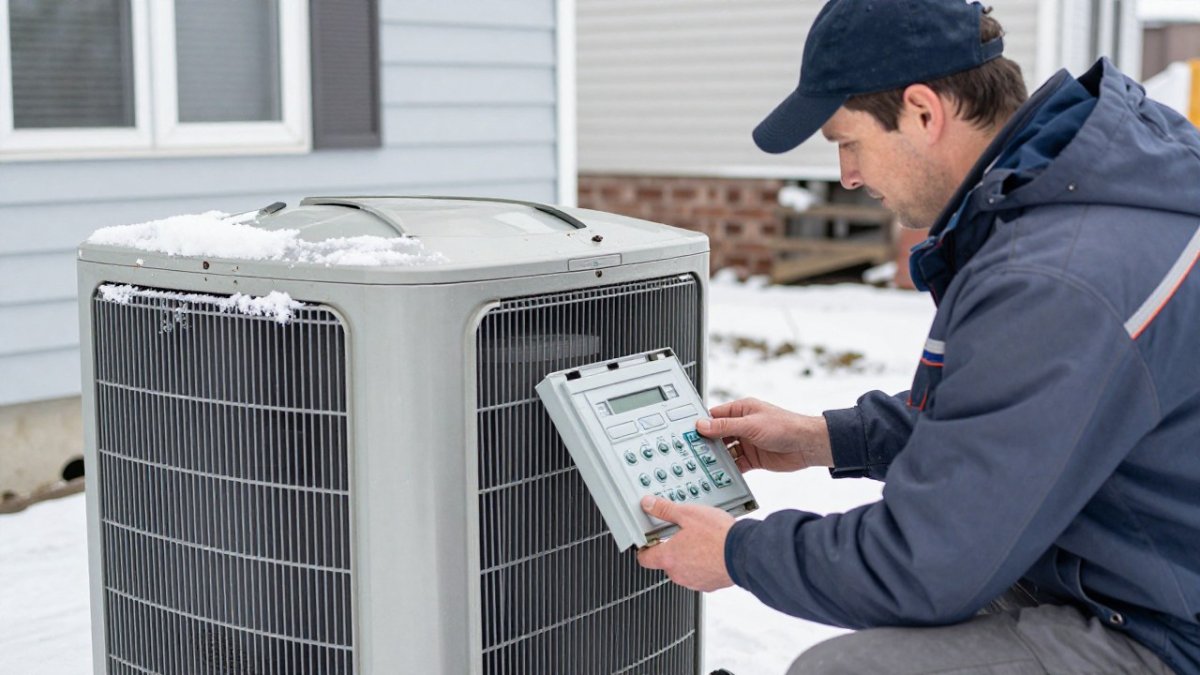
Defrost is the other cold-weather mechanism homeowners notice. In cold, humid conditions the outdoor coil can frost, and the system periodically reverses to melt it. That cycle is normal, but a system that defrosts frequently or runs in defrost for long stretches is a sign of a sizing, charge, or control problem worth diagnosing.
A dual-fuel system, pairing a heat pump with a furnace as backup heat, is a smart setup for our region. The heat pump handles most of the year efficiently, and the furnace covers the coldest nights.
The research backs up the range of conditions these systems face. A case study presented to the American Council for an Energy-Efficient Economy examined an air-source heat pump’s performance across outdoor temperatures from -10°F to 100°F, along with how sizing and loading affect results.
Watch out: a heat pump sized only to the cooling load can leave the house short on capacity at the design heating temperature, which pushes auxiliary heat to run more than it should.
If your system is struggling in a cold snap, contact Barber Plumbing & Heating for 24/7 emergency support.
Sizing, Ductwork and Installation Quality Decide the Outcome
A heat pump only performs as well as its installation. Oversized equipment short-cycles, undersized equipment strains, and leaky ducts waste the efficiency you paid for. Correct sizing, sealed ductwork, and a careful install matter more than the model number on the box.
Consumer Reports published a 2026 review of four whole-house heat pumps, described as lab-tested, and the takeaway for buyers is that the equipment matters, but the setup matters just as much.
Before any install, a good contractor checks your home’s heat load, inspects the ducts, and confirms the electrical panel can handle the new equipment. Skipping those steps is how homeowners end up with a system that never delivers its rated efficiency. If you’re wondering how long the job takes, our guide on how to plan HVAC installation time walks through what to expect.
Book a Heat Pump Assessment With a Family-Owned Team
The right next step is a professional assessment, not a guess. We’re a multi-generational, family-owned business with over 75 years of combined experience, and we’ve served Chester and Lancaster County for more than 20 years.
We’ll review your existing HVAC system and give you a straight answer on whether a high-efficiency heat pump makes sense for your house. We’re certified by the Chester County Board of Health for pump installation, and we offer 24/7 emergency support year-round.
When you’re ready, contact Barber Plumbing & Heating to schedule your assessment. For urgent heating problems, call 610-273-2369.
A heat pump decision deserves more than a spec sheet. Let our family-owned team assess your home, explain your options in plain terms, and install a system built to last. Get started with Barber Plumbing & Heating and enjoy reliable, efficient comfort through every season.
Frequently Asked Questions
What is the major disadvantage of a heat pump?
The upfront cost is the biggest drawback. A higher purchase and installation price than conventional HVAC equipment is a key downside. Savings are not guaranteed to be identical in every home, since results vary by house, climate and electricity prices. Older homes with leaky ducts or poor insulation often see less than expected unless those issues are fixed first.
Are high-efficiency heat pumps worth it compared with a standard model?
It depends on how much you run the system and how cold your winters get. A high-efficiency unit costs more upfront but uses less electricity for the same heat, so the gap narrows the longer you stay in the home. Heat pumps move heat rather than generating it, which is why they can be efficient to run. Ask for a load calculation before deciding.
How well do heat pumps handle cold weather?
Modern cold-climate models keep working well below freezing, though heating capacity and efficiency drop as outdoor temperature falls. Many installations pair the heat pump with a backup or dual-fuel system so the furnace covers the coldest stretches.
Why is my electric bill so high with a heat pump?
A few common causes explain most spikes. Backup electric resistance strips kicking in during cold snaps use far more electricity than the compressor, so a system that is undersized or has a misconfigured switchover temperature will lean on them too often. Duct leaks, dirty filters and low refrigerant also force the unit to run longer. If your bill jumped after installation, ask your contractor to check the balance point settings and confirm the system was sized with a proper load calculation.