

Last Updated: November 21, 2026
Quick Summary
To answer what to do if your well pump keeps cycling, first confirm the symptom and check the pressure gauge, then shut off power at the breaker and test the pressure tank’s precharge with the tank drained. If the tank holds air, inspect the pressure switch, check valve, and plumbing for leaks, and call a licensed professional for any wiring or well-side work.
- A normal well pump should not cycle at all when every faucet is closed.
- Test precharge pressure with the pump off and the tank fully drained of water.
- Precharge should sit about 2 psi below the pressure switch cut-in setting.
- Replace the tank if water spits from the air valve or it won’t hold precharge overnight.
- Shut the main house valve and watch the gauge to isolate a plumbing leak from a well-side leak.
Table of Contents
- How a Normal Well Pump Cycle Works and Why Yours Keeps Cycling
- A Safe, Ordered Diagnostic Flow Before You Touch Anything
- How to Fix Short Cycling Well Pump Problems: Test the Pressure Tank First
- Pressure Switch, Check Valve, and Plumbing Leaks: The Other Causes
- How Often Should a Well Pump Cycle When Not in Use?
- Cause-and-Symptom Troubleshooting Chart for Cycling Pumps
- When to Stop Troubleshooting and Call a Well Pump Professional
- Book a Well Pump Inspection With Barber Plumbing & Heating
- Frequently Asked Questions
How a Normal Well Pump Cycle Works and Why Yours Keeps Cycling
Wondering what to do if your well pump keeps cycling? You already know the sound: the pump kicks on, runs a short while, shuts off, then starts again minutes or even seconds later.
Short cycling is when a well pump starts and stops far more often than it should. The pressure tank is supposed to act like a cushion.
A common mistake is blaming the pump itself. If you want to know whether an aging pump is part of the problem, our guide on how long a well pump lasts covers the warning signs of failure.
Rapid Cycling vs. Slow or Intermittent Cycling
Rapid cycling means on-off-on within seconds to a couple of minutes. Slow or intermittent cycling means the pump runs longer but restarts more often than normal, often after you use water.
- Rapid cycling: usually a waterlogged tank or a bad pressure switch
- Slow cycling: often a small leak, a failing check valve, or a tank losing its air charge
- Cycling only when water runs: points to the tank or switch
- Cycling when nothing is running: points to a leak or a check valve letting water back down the well
That last pattern matters most. A pump that cycles with every faucet closed is losing pressure somewhere it shouldn’t.
A Safe, Ordered Diagnostic Flow Before You Touch Anything
Start with safety, then work from the simplest check to the hardest. The safe order is: confirm the symptom, check the pressure gauge, test the tank, then inspect the switch and plumbing. Never open an electrical panel or touch wiring unless you are qualified.
Here is the flow we recommend:
- Listen and time it. Note how long the pump runs and rests.
- Watch the pressure gauge. Does it hold steady, or drop the moment the pump stops?
- Shut off power to the pump at the breaker before any physical check.
- Test the pressure tank (covered below).
- Inspect the pressure switch, check valve, and visible plumbing for leaks.
- Call a pro if anything involves wiring, a dropping gauge with no obvious cause, or a pump that won’t hold pressure.
If the cycling turns into a total loss of water or a wet electrical area, stop and treat it as urgent. Our team’s guidance on fixing a well pump emergency safely walks through what to do first.
How to Fix Short Cycling Well Pump Problems: Test the Pressure Tank First
The pressure tank is the first place to look, and testing it is a job most homeowners can do safely. A tank that has lost its air charge, or whose internal bladder has failed, cannot hold pressure. The pump then short-cycles to keep up.
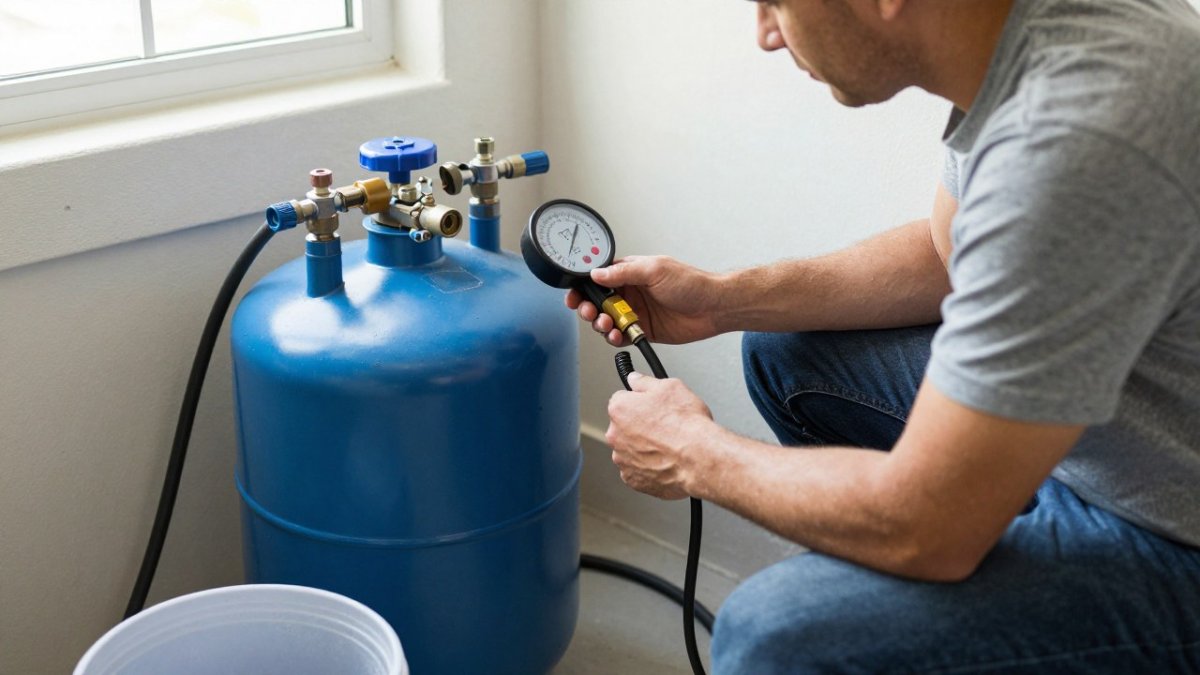
Checking Precharge Pressure With the Power Off and the Tank Drained
Precharge is the air pressure inside the tank, set before water enters. To test it correctly, the tank must be empty of water and the pump must be off. Measuring with water still in the tank gives a false high reading and hides a failed bladder.
- Turn off power to the pump at the breaker
- Open a nearby faucet to drain the water pressure
- Let the tank empty completely, then close the faucet
- Remove the cap on the air valve (Schrader valve) on top of the tank
- Check the air pressure with a tire gauge
- Compare the reading to the tank’s precharge setting, usually printed on the tank label
A tank that reads low, or that spits water from the air valve, has a failed bladder. Water where air should be means the tank needs replacement, not just air.
How Precharge Relates to the Pressure Switch Cut-In Setting
The precharge is not arbitrary. It should sit about 2 psi below the pressure switch cut-in setting. Check your tank label and switch settings for the exact values.
If precharge is too low, the pump has to work harder to reach cut-out and the tank holds less usable water, so the pump cycles more often. If precharge is too high, the pump may not be able to push water into the tank at all, and the switch can chatter.
Adding Air to a Waterlogged Tank
If the tank holds air but the reading is low, you can add air with a bicycle pump or small compressor through the Schrader valve. Add air slowly, checking with the gauge as you go, until you reach the tank’s stated precharge.
Watch out: adding air to a tank with a ruptured bladder does nothing. The air escapes into the water side and the cycling returns within days. If the gauge won’t hold a reading, stop and plan for a new tank.
When to Replace the Tank Instead of Recharging It
Recharging buys time only if the bladder is intact. Replace the tank when water comes out of the air valve, when the tank won’t hold precharge overnight, or when the tank is visibly rusted or leaking at the seams. A tank that keeps losing air is a tank that will keep short-cycling your pump.
Pressure Switch, Check Valve, and Plumbing Leaks: The Other Causes
If the tank tests fine, the next suspects are the pressure switch, the check valve, and leaks. The pressure switch turns the pump on and off at set pressures (cut-in and cut-out). A switch with dirty contacts or wrong settings causes frequent starts.
Pressure Switch Problems and Settings
The switch is a small box on the pump line with two spring adjustments: one for cut-in and one for cut-out. The difference between them is the differential. A typical switch is set at 30/50 or 40/60 psi.
Signs of a switch problem include rapid clicking with the pump stuttering, a pump that won’t start at the expected pressure, or contacts that look burned or pitted.
Check Valve Failure Symptoms
A failing check valve lets water drain back down the well after the pump stops. The pump then restarts to rebuild pressure, even with no water in use. The telltale sign is a pressure gauge that climbs to cut-out, the pump shuts off, and the gauge immediately starts falling with every faucet closed. A bad check valve also lets the pump lose its prime, so you may see air sputtering at faucets or a pump that runs without building pressure.
Isolating a Plumbing Leak From a Well-Side Leak
To tell a plumbing leak from a well-side problem, shut off the main valve to the house and watch the gauge. If pressure still drops, the loss is on the well side. If it holds, the leak is inside the home.
If cycling has left you with weak or lost pressure, our guide on what to check when there’s no water covers the next steps.
How Often Should a Well Pump Cycle When Not in Use?
A well pump should not cycle at all when no water is running. With every faucet closed, the pump should stay off. If it starts and stops on its own, pressure is escaping somewhere.
Some cycling during heavy use is normal, since the pump refills the tank as water is drawn. Knowing what to do if your well pump keeps cycling with the water off means finding the pressure loss, not adjusting the switch to hide it.
Cause-and-Symptom Troubleshooting Chart for Cycling Pumps
Use this chart to match what you’re seeing to the likely cause before you call anyone.
| Symptom | Likely Cause | What to Do |
|---|---|---|
| Pump cycles every few seconds | Waterlogged tank or failed bladder | Test precharge with power off |
| Cycles only when water runs | Low tank air charge | Add air to precharge level |
| Cycles with all faucets closed | Leak or bad check valve | Shut house valve, watch gauge |
| Pressure drops fast after pump stops | Failing check valve | Call a pro to inspect the well side |
| Pump runs but pressure stays low | Clogged line or worn pump | Professional diagnosis |
| Switch clicks rapidly, pump stutters | Pressure switch problem | Do not adjust wiring yourself |
When to Stop Troubleshooting and Call a Well Pump Professional
Stop and call a pro when the problem involves electricity, a pump that won’t hold pressure, water spraying near wiring, or a gauge that drops with no clear cause. Anything past the pressure tank and switch is best left to a licensed well pump technician.
As certified Chester County Board of Health pump installers, our team at Barber Plumbing & Heating handles well pump diagnosis, repair, and replacement. If you need well pump installation or repair, we can find the cause and fix it fast. Before you commit, it helps to understand what a well pump replacement involves.
Book a Well Pump Inspection With Barber Plumbing & Heating
A pump that keeps cycling wastes energy and wears out the motor faster. The sooner you trace the cause, the more you save on repairs.
Barber Plumbing & Heating is a multi-generational, family-owned business with over 75 years of combined experience, serving homeowners across the area with 24/7 emergency support. For urgent problems, call 610-273-2369.
Contact Barber Plumbing & Heating to request an estimate.
Frequently Asked Questions
Why is my well pump constantly cycling?
The most common reason is a waterlogged pressure tank or a bladder that has failed. When the tank can no longer hold its air charge, water pressure swings fast and the pump restarts within seconds instead of minutes. A pressure switch set too close together, a failing check valve, or a leak between the well and the house can cause the same pattern. Test the tank air charge first, because it is the cheapest and most frequent culprit in well pump cycling.
How often should a well pump cycle when no water is being used?
A healthy system should not cycle at all when every fixture is closed. If the pump turns on and off every few minutes with no water running, something is wrong: a leaking check valve, a toilet flapper passing water, or a pressure tank that has lost its air charge. A pump that runs once and then stays off until you open a tap is behaving normally. Log the interval between starts for an hour to see the pattern clearly.
Can a faulty pressure tank cause short cycling?
Yes. The tank stores a cushion of compressed air that lets the pump run in longer, less frequent stretches. When the bladder tears or the air charge bleeds out, that cushion disappears and the tank fills with water. The pump then hits cut-out pressure almost immediately and restarts as soon as a tap opens. Testing precharge pressure with the power off and the tank drained tells you whether the tank is the cause or whether to look at the switch and plumbing.
When should I call a professional about a cycling well pump?
Call a professional if the pump cycles after you have verified the tank air charge, if you smell burning or hear grinding from the motor, if the breaker trips, or if the pump runs continuously without building pressure. These point to motor wear, a failing check valve down the well, or a wiring fault that needs a licensed technician. Barber Plumbing & Heating is a multi-generational family owned business with over 75 years of combined experience and certified pump installers, and offers 24/7 emergency support for urgent failures.