

Last Updated: November 5, 2026
Quick Summary
A sump pump battery backup is worth it for most homes with a finished basement or a history of water problems, because it takes over automatically when the power fails or the primary pump quits. For a bare concrete crawlspace with no flooding history, it may be money you can spend elsewhere.
- A backup pump sits in the same pit with its own float switch and discharge line.
- Runtime depends on battery capacity, pump head, inflow rate, and cycling frequency.
- A second primary pump still needs electricity, so it does nothing during an outage.
- A water-powered backup runs on household water pressure but uses a lot of water per cycle.
- Two or more yes answers on the risk questions point toward installing one.
Table of Contents
- Is a Sump Pump Battery Backup Worth It? The Real Answer
- How a Battery Backup Sump Pump Protects Your Basement
- Battery Backup Sump Pump Runtime: What to Expect in a Storm
- Battery Backup vs. Second Sump Pump: Which Fits Your Home?
- Water-Powered Backup Sump Pump: Pros, Cons, and When to Choose One
- Sump Pump Battery Backup Installation: What the Job Involves
- Weighing the Cost Against Basement Flooding Risk
- Schedule a Sump Pump Evaluation With Barber Plumbing & Heating
- Frequently Asked Questions
Is a Sump Pump Battery Backup Worth It? The Real Answer
A sump pump battery backup is a secondary pump powered by a charged battery that takes over when the power fails or the primary pump quits. For most homes with a finished basement or a history of water problems, it is worth it. For a bare concrete crawlspace with no history of flooding, it may be money you can spend elsewhere.
Your primary pump is only as reliable as the power supply. Storms can knock out electricity, and that is exactly when water can pour in.
Below, we break down how these systems work, how long they actually run, and how to decide for your own basement.
How a Battery Backup Sump Pump Protects Your Basement
Water damage is the expensive part. A backup pump keeps water moving out of the pit when the main pump has no power.
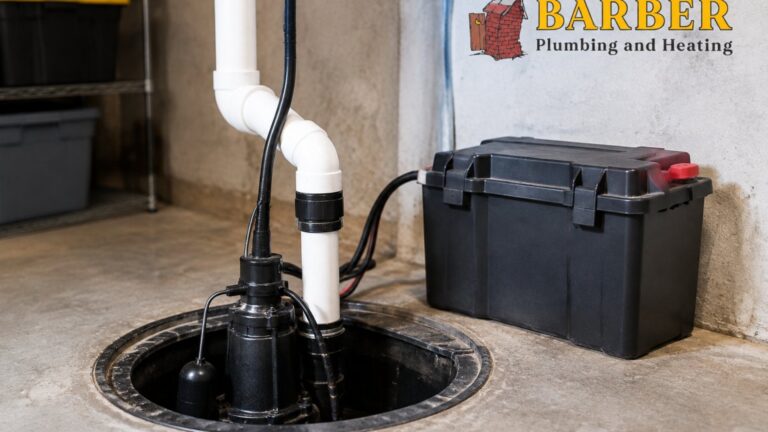
The setup is simple. A battery-powered pump sits in the same sump pit or beside it, with its own float switch and its own discharge line. When water rises and the primary pump stays silent, the backup kicks on by itself.
That automatic operation matters most during heavy rain and storms, when power outages and high water tables hit together. For related protection against water where it should not be, see our pipe leak detection and repair service.
What it does not do:
- It will not run forever. Runtime depends on battery size and how hard the pump works.
- It will not fix a pump that failed because the pit is clogged with debris.
- It will not replace a primary pump that is already dead.
Think of it as a fail-safe, not a full replacement.
Battery Backup Sump Pump Runtime: What to Expect in a Storm
Battery backup sump pump runtime is the number that decides whether the system protects your basement during an outage. Real runtime is a function of several variables: battery capacity, pump head, inflow rate, and cycling frequency.
Battery capacity. Deep-cycle batteries are rated in amp-hours (Ah). A larger Ah rating stores more energy, but usable capacity is lower than the label because discharge rate and depth-of-discharge limits matter.
Pump head. The vertical lift from the pit to the discharge point plus friction losses in the pipe determine how hard the pump works. A higher head means the pump draws more current per minute of operation, which shortens runtime.
Inflow rate. The rate at which water enters the pit sets how often the pump cycles. A high water table during a storm can cycle the pump many times per hour, and each cycle has a startup current draw that is higher than steady running.
Cycling frequency and duty cycle. A pump that runs for 30 seconds every few minutes is doing less work than one that runs continuously, but startup surges add up.
A fully charged, correctly sized deep-cycle battery paired with a modest pump and a short discharge run can handle a short outage of a few hours. The same battery with a high-head discharge and a fast-filling pit may last a fraction of that.
Here is the honest limit. A battery backup handles short outages well. A storm that cuts power for days is a different problem, and some homeowners argue a battery alone is not enough without a whole-home backup plan. That is a fair point.
A simple maintenance routine keeps runtime where it should be:
- Test the pump every few months by lifting the float
- Check the battery charger indicator light
- Clean the float switch and pit of debris
- Replace the battery on the maker’s schedule, not when it dies
- Confirm the discharge line is clear before storm season
A battery that shows a charged indicator can still fail under load if it is old or was deeply discharged repeatedly, so load-testing is the reliable way to confirm it will carry the pump during an outage.
Battery Backup vs. Second Sump Pump: Which Fits Your Home?
A second primary pump and a battery backup solve different problems. Choosing wrong leaves a gap.
A second pump gives you redundancy against pump failure. But it still needs electricity. If the power is out, two primary pumps do nothing.
A battery backup gives you protection against electrical failure. That is the scenario storms create.
|
Option |
Protects Against |
Needs Power? |
Best For |
|---|---|---|---|
|
Battery backup |
Power outage, main pump failure |
No, runs on battery |
Storm-prone homes, finished basements |
|
Second primary pump |
Pump mechanical failure only |
Yes |
Homes with frequent pump breakdowns |
|
Both together |
Outage and pump failure |
Partly |
High-risk basements, high water tables |
For most homes, the battery backup is the smarter first add-on. A second pump makes sense when your primary pump has a history of quitting.
Best for: homes that lose power during storms. Skip if: your pit has never taken on water and the basement is unfinished.
Water-Powered Backup Sump Pump: Pros, Cons, and When to Choose One
A water-powered backup sump pump uses your home’s water pressure to pull water out of the pit. No battery, no charger, no runtime clock.
The upside is real. It runs as long as you have water pressure, so long outages do not drain it. There is no battery to maintain or replace.
The catch is equally real:
- It uses a lot of water per cycle, which shows up on your bill.
- It needs solid household water pressure to work.
- It cannot run if your water supply is also out.
So it fits homes on reliable municipal water with a flooding risk that outlasts a battery. It fits poorly on a private well, where losing power often means losing the pump and the water pressure together.
If your home runs on a well, a battery system is usually the better match. Our team handles well pump and water issues as part of our plumbing service work.
Sump Pump Battery Backup Installation: What the Job Involves
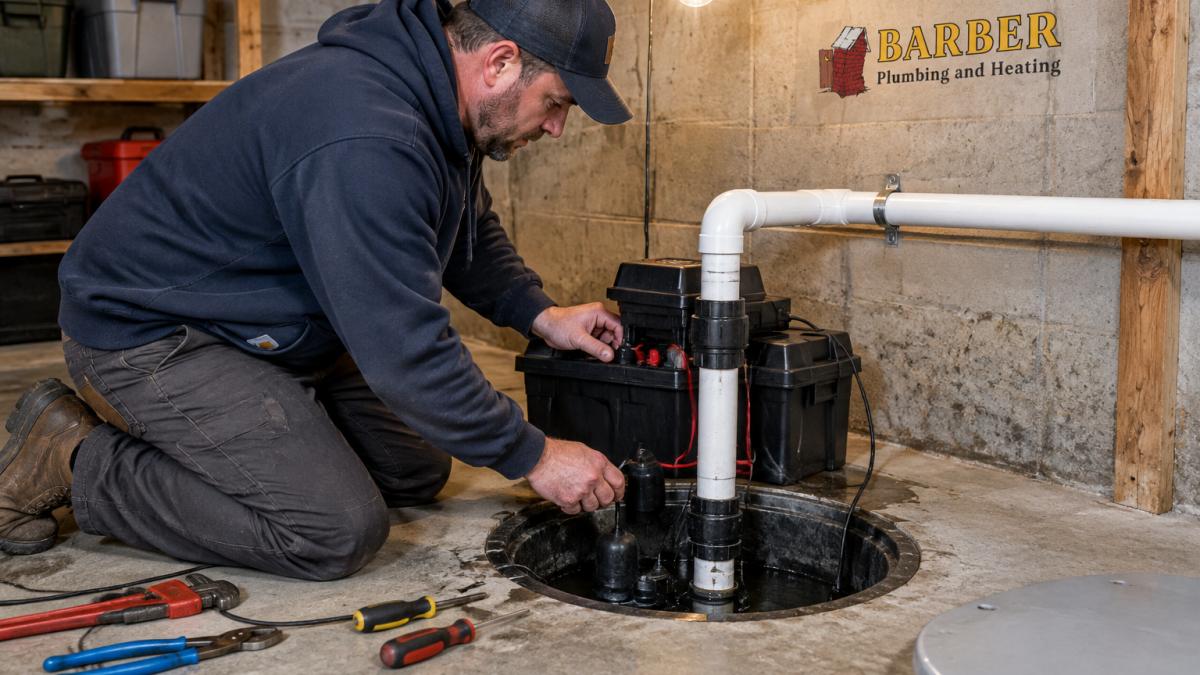
Installation is not a drop-in job. It can involve fitting a second pump, a battery box, a charger, and a separate discharge line so the two systems do not interfere with each other.
A typical install includes:
- Setting the backup pump in or beside the sump pit
- Mounting the battery and charger on a stable, dry surface
- Running a dedicated discharge line with a check valve
- Wiring the float switch and alarm
- Testing both pumps under load before calling it done
Watch out: a backup tied into the primary pump’s discharge line without a check valve can push water backward and burn out both pumps.
If you want the work done right the first time, our team can install a sump pump backup and test it before we leave.
Weighing the Cost Against Basement Flooding Risk
Here is the calculation that answers the question for your home. Compare what the backup costs against what one flood would cost you, then weigh that against the probability of a flood during an outage. The result is not a single number for every home, but the framework makes the decision concrete.
Start with the cost side. A battery backup system generally includes the backup pump, a deep-cycle battery, a charger, a discharge line, and installation labor. Pricing depends on the equipment and the job, so contact Barber Plumbing & Heating for a quote. The purchase price is only part of ownership cost.
Now the risk side. A finished basement changes the math completely. Carpet, drywall, furniture, and electronics add up fast. Add cleanup, mold and mildew removal, and replaced belongings, and a single flood can cost far more than a backup system. A bare basement with a floor drain is a different story.
Probability matters too. Homes that lose power often during storms, sit on a high water table, or have a pit that fills fast in heavy rain face a higher chance of a flood coinciding with an outage. Homes on stable power with a dry pit and no history of water intrusion face a lower chance.
Ask yourself:
- Is the basement finished or used for storage?
- Has water ever come in during a storm?
- Does the pit fill fast in heavy rain?
- Do you lose power often in storms?
- How long do outages typically last in your area?
Two or more yes answers point toward installing one. For homeowners weighing the spend, financing options can spread the cost of the project.
Watch out: comparing only the purchase price to a flood repair bill overstates the case for a backup in low-risk homes and understates it in high-risk ones. Use lifetime cost against expected flood cost, not sticker price against worst-case repair.
Schedule a Sump Pump Evaluation With Barber Plumbing & Heating
The right answer depends on your pit, your basement, and your storm history. A short evaluation settles it.
Barber Plumbing & Heating is a multi-generational, family-owned business with over 75 years of combined experience, and we are certified by the Chester County Board of Health as pump installers. We will look at your current pump and tell you plainly whether a backup is worth it for your home.
We also offer 24/7 emergency support when water is already coming in.
Have questions about how we work first? Our FAQ page covers the common ones. Ready to book? Contact our team and we will set up a time to evaluate your sump pump.
Frequently Asked Questions
How long will a battery backup last on a sump pump?
Runtime depends on the battery’s capacity and charge, the pump’s workload, and how often it cycles. That window shrinks when the pump cycles often during heavy rain. Runtime also drops as the battery ages, so test it every few months and replace it every three to five years. If outages in your area routinely last days, pair the battery with a generator or plan for a longer-term backup.
Is a battery backup sump pump better than a second primary pump?
They solve different problems. A second primary pump adds capacity for heavy water volume but still stops when the power goes out. A battery backup keeps pumping during an outage, which is the scenario that causes most basement flooding. If your pit fills fast during storms and you already lose power, a battery backup covers the more likely failure. Some homeowners install both for full coverage.
Can a water-powered backup sump pump replace a battery system?
A water-powered backup sump pump uses your home’s water pressure to pull water from the pit, so it never needs a battery and runs as long as the supply holds. The tradeoff is that it uses a significant amount of water per cycle and depends on municipal pressure. It suits homes with reliable water service and moderate inflow. Homes on a well or with low pressure should lean toward a battery backup instead.
How often should you replace a sump pump backup battery?
Most deep-cycle batteries last three to five years, but heat, frequent cycling, and poor charging shorten that. Test the battery under load every three to four months and watch for slower pumping or a weak alarm. Replace it at the first sign of decline rather than waiting for a storm. A fresh battery is far cheaper than cleaning up a flooded finished basement.
Your basement is only as protected as its weakest link, and a dead pump during a storm is that link. Let us check your setup before the next heavy rain, not after. Get started with Barber Plumbing & Heating and get a clear answer on whether a battery backup fits your home.