

Quick Summary
To choose a local HVAC contractor, first verify the license, liability insurance and workers’ compensation coverage yourself, then compare at least three written estimates on scope rather than price. Ask whether a load calculation was performed before the system size is recommended.
- Ask for the license number and look it up with your state or local licensing board.
- Confirm the insurance certificate is current and names your property.
- Get at least three written estimates and compare them on scope, not the bottom-line number.
- Ask whether a load calculation was performed before accepting a system size.
- Be wary of large upfront deposits and pressure to sign the same day.
Table of Contents
- How to Choose a Local HVAC Contractor: What to Check First?
- Why the Right Local HVAC Contractor Matters for Your Home
- Verify Licensing, Insurance and Certifications First
- Check Reviews, References and Local Reputation
- Questions to Ask an HVAC Contractor Before You Hire
- How to Compare HVAC Quotes Side by Side
- Load Calculations, System Sizing and Repair vs. Replacement
- HVAC Replacement Checklist and ENERGY STAR Installation Standards
- Booking Your Local HVAC Contractor With Confidence
- Frequently Asked Questions
How to Choose a Local HVAC Contractor: What to Check First?
Last Updated: November 2, 2026
Why the Right Local HVAC Contractor Matters for Your Home
Choosing a local HVAC contractor is one of the most important decisions a homeowner makes for comfort and safety. A good contractor keeps your heating and cooling running well, and a poor one can leave you with repeat repairs and an oversized or undersized system.
This guide walks through what to check first when you need to choose a local HVAC contractor.
What a good contractor does:
- Explains the problem before recommending equipment
- Shows proof of license and insurance
- Gives a written estimate that spells out the work
- Answers your questions without pressure
Verify Licensing, Insurance and Certifications First
Start with the basics before you look at prices. Ask for proof of licensing, liability insurance and workers’ compensation coverage. A contractor without these can leave you liable if someone is hurt on your property.
Check the paperwork yourself. Do not rely only on a logo or a claim on a website.
- Ask for the license number and look it up with your state or local licensing board
- Confirm the insurance certificate is current and names your property
- Look for manufacturer training or certifications on the equipment they install
- Ask whether technicians are employees or subcontractors
Ask for the documents in writing before work begins.
Check Reviews, References and Local Reputation
Reviews show patterns, and a single review rarely tells the whole story. Look for consistent comments about punctuality, honesty and follow-up service over several months.
Ask the contractor for three recent references in your area. Call at least two of them and ask whether the job finished on time and on budget.
Check where the contractor serves and how quickly it responds to emergency calls.
Questions to Ask an HVAC Contractor Before You Hire
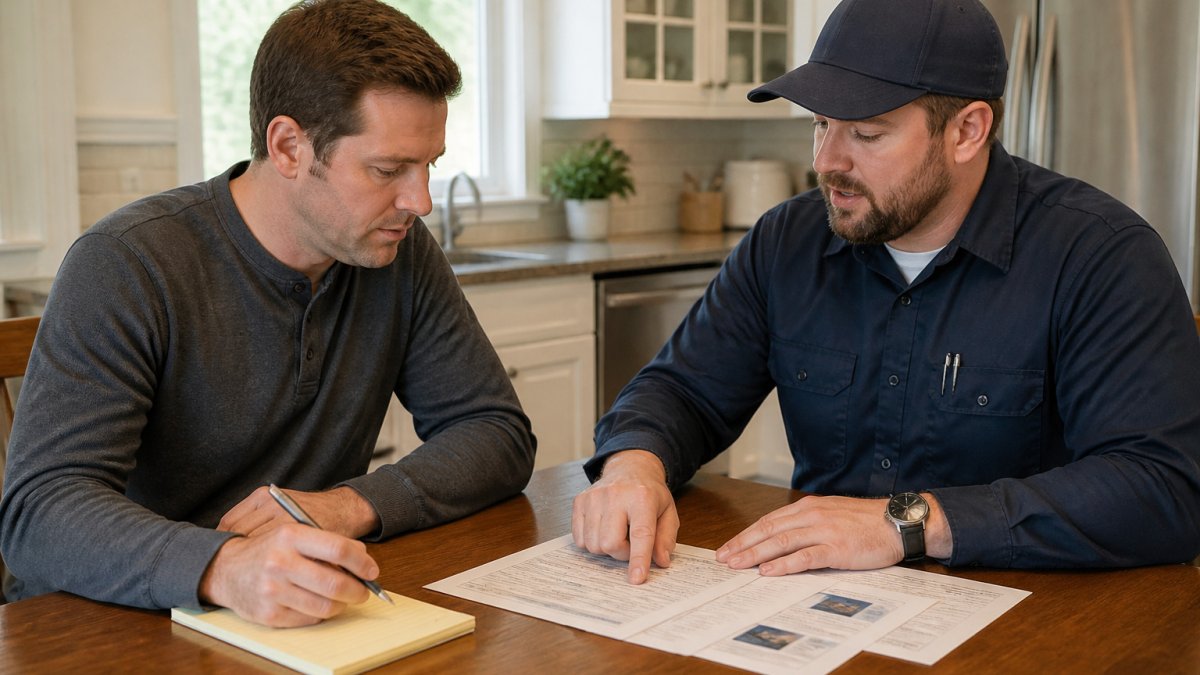
Use these questions to compare contractors on equal terms:
- How long have you served this area?
- Who will actually do the work, and are they trained on my system type?
- Do you offer 24/7 emergency service, and is there an extra fee?
- Will you perform a load calculation before recommending a system size?
- What does your warranty cover on parts and labor?
- Will you pull the required permits and schedule inspections?
Listen for direct answers. Vague replies or pressure to decide today are warning signs.
How to Compare HVAC Quotes Side by Side
Get at least three written estimates, and compare them on scope rather than on the bottom-line number. A low bid often leaves out permits, removal and disposal of the old unit, duct sealing, or the labor warranty, costs that reappear after you sign. If budget is a concern, you can review financing options before comparing quotes. The goal is to make every bid describe the same job so the prices mean the same thing.
Normalize the bids before you compare price
Build a one-page worksheet with the same rows for every contractor, and fill it in from each written estimate, not from what the salesperson said at the kitchen table. If a line is blank or vague, write “not specified” and ask the contractor to put it in writing.
- Equipment: brand, model number, nominal tonnage or BTU, SEER2/HSPF2 or AFUE rating, and whether it is a single-stage, two-stage, or variable-speed unit
- Sizing basis: was a load calculation performed and documented, or is the new unit matched to the old one’s capacity?
- Scope of labor: what is removed, what is reused (line set, plenum, ductwork, thermostat), and what is new
- Ductwork: inspection, sealing, repair, or replacement, and whether it is included or an add-on
- Permits and inspections: who pulls the permit, who pays the fee, and who schedules the inspection
- Electrical, gas, and condensate work: included, subcontracted, or excluded
Read the price through the scope
Once the rows are filled, compare like with like. If one bid is materially lower, the difference is usually in one of four places: a smaller or lower-efficiency unit, missing permit and inspection costs, no ductwork work, or a shorter labor warranty.
A common pattern is a bid that quotes a replacement price but excludes the permit, the crane or haul-away, or the thermostat, items that add cost after the contract is signed. The written estimate should state whether those are included.
Contract and deposit red flags
Watch out: a deposit that is a large share of the total, before any equipment is ordered, is a warning sign, a reasonable deposit is usually a modest percentage of the contract, with the balance tied to completion and inspection. Other red flags in the paperwork:
- A scope described only in general terms (“install new system”) with no model numbers or labor detail
- Verbal promises about warranty, rebates, or cleanup that do not appear in the contract
- Pressure to sign the same day to lock in a price, or a discount that expires when the salesperson leaves
- A payment schedule that front-loads most of the cost before work begins
- No stated process for change orders if the job uncovers unexpected work
Ask for the contract to be sent home for review, and compare it against the worksheet before signing.
The worksheet below lists the scope items to compare across written estimates, so each bid describes the same job.
|
Item |
What to confirm |
Why it matters |
|---|---|---|
|
Equipment |
Brand, model, tonnage or BTU, efficiency rating |
Shows exactly what you are buying |
|
Sizing basis |
Load calculation performed and documented |
Oversizing or undersizing drives comfort and efficiency |
|
Ductwork |
Inspection, sealing, repair or replacement |
Often an add-on that changes the price |
|
Permits and inspections |
Who pulls permit, pays fee, schedules inspection |
Costs that appear after signing if unspecified |
|
Warranty |
Parts and labor coverage, and who provides it |
Labor warranty may come from manufacturer or contractor |
|
Deposit |
Amount and payment schedule |
Large upfront deposits are a warning sign |
|
Exclusions |
Items the bid explicitly does not cover |
Explains most gaps between low and high bids |
Load Calculations, System Sizing and Repair vs. Replacement
A properly sized system heats and cools your home efficiently (HVAC Proper Sizing of HVAC Systems). An oversized unit cycles on and off, wastes energy, and leaves humidity control uneven; an undersized unit runs constantly and never reaches the set temperature on the hottest or coldest days. Sizing is a calculation, not a guess, and it is one of the clearest ways to judge whether a contractor is doing the job properly.
What a proper load calculation involves
Ask whether the contractor performed a load calculation, commonly a Manual J calculation, and whether you will receive the results in writing. A credible assessment looks at the home, not just the square footage:
- Insulation levels in walls, attic, and crawlspace or basement
- Window type, size, orientation, and shading
- Air leakage and duct location (conditioned or unconditioned space)
- Ceiling height, number of stories, and room-by-room layout
- Occupancy and appliance heat gain
- Local design temperatures for heating and cooling
The output is a room-by-room heating and cooling load in BTUs, which then drives equipment selection (often via Manual S) and duct design (often via Manual D).
Watch out: if the contractor cannot say what calculation was run, or offers only “we’ll match what’s there,” ask for the load calculation before signing. A system that was oversized from the start will keep cycling and under-dehumidifying even after replacement.
Repair versus replacement
Use the contractor’s reasoning, not just the price, to decide:
- Repair is often the better call when the system is roughly under 10 years old, the repair cost is modest relative to replacement, and the failure is a single component (capacitor, blower motor, igniter, contactor).
- Replacement is often the better call when repairs are frequent, the system is near or past its expected service life, efficiency is low, or the repair cost approaches a meaningful share of a new system.
- Refrigerant transition: systems using older refrigerants face rising service costs as supplies tighten; ask the contractor how that affects repair economics before committing to a fix.
Ask the contractor to put the reasoning in writing: what failed, what the repair buys you in years, and what a replacement would include. That written comparison is more useful than a verbal recommendation.
Match the questions to the job type
The criteria shift with the project. For an emergency no-heat or no-cool call, prioritize 24/7 availability, diagnostic fees, and whether the technician carries common parts. For a planned replacement, prioritize the load calculation, equipment match, duct assessment, permit and inspection, and commissioning. For a new installation or addition, ask about duct design and room-by-room sizing from the start. Using the same checklist for every job type is how homeowners end up comparing bids that were never equivalent.
HVAC Replacement Checklist and ENERGY STAR Installation Standards
If you are replacing a system, use this checklist to confirm the job is done right:
- Load calculation completed and documented
- ENERGY STAR-certified equipment where it fits your budget
- Ductwork inspected and sealed
- Thermostat, filters and drain lines checked
- Permits pulled and inspections passed
- Startup test and refrigerant charge recorded
- Written warranty for parts and labor
Ask your contractor whether the installation follows the manufacturer’s and industry installation guidance, and request the commissioning results in writing. If you have decided to replace equipment, you can browse our new furnace and heat pump installation options. You can review our home service agreement plans to see how ongoing maintenance is handled.
Booking Your Local HVAC Contractor With Confidence
Once you have checked licensing, reviews, quotes and sizing, book the contractor who answered your questions clearly and put the details in writing. Barber Plumbing & Heating offers 24/7 emergency service and certification as Chester County Board of Health pump installers. You can visit our website for current information or to request a quote.
If you want to confirm we serve your area before you call, you can check our service area.
Frequently Asked Questions
How do I verify an HVAC contractor’s license and insurance?
Ask for the contractor’s license number and look it up with your state licensing board, which typically lists the license status and any disciplinary actions. Request a certificate of insurance directly from the insurer rather than accepting a copy the contractor hands you, and confirm that both general liability and workers’ compensation coverage are active. Check that the names on the license and insurance match the company you are hiring. Local licensing requirements vary, so confirm what your county or city requires for the specific work.
How many quotes should I get before choosing an HVAC contractor?
Getting at least three written quotes gives you a realistic sense of the market for your system and location. Ask each contractor to base the estimate on a load calculation for your home rather than a rule of thumb about square footage. Compare the equipment model, efficiency rating, warranty terms, and what the price includes, such as permits, removal of the old unit, and ductwork changes. A much lower bid often means something is missing from the scope of work.
What should I check before signing an HVAC contract?
Read the full written contract before paying any deposit, and make sure the scope of work, equipment model numbers, total price, payment schedule, and warranty terms are all spelled out. Be cautious of contractors who pressure you to sign the same day, demand large cash deposits, or refuse to put verbal promises in writing. Confirm who pulls the permits and schedules the required inspections. Keep copies of every signed document and all warranty paperwork.
Is it worth paying more for a local HVAC contractor?
A higher price is not automatically better, but a contractor who is established in your area, familiar with local permit and inspection requirements, and available for future service often delivers more value over the life of the system. Compare what each quote includes rather than the bottom line alone. Ask about response times for emergency service and whether the company offers a workmanship guarantee in addition to the manufacturer’s warranty.