

Quick Summary
A private well has no utility testing the water before it reaches your tap. That makes it your responsibility, and testing is the simplest way to catch a problem early.
Test yearly for the basics
Total coliform bacteria, nitrates, total dissolved solids, and pH, through a PA-certified lab.
Retest sooner after certain events
Flooding, well or pump repairs, a sudden change in taste or smell, or moving in without recent records.
Looks can be misleading
Clear water is not proof it is safe. Testing gives you real data instead of a guess.
Test before you treat
The right equipment depends on what the lab finds, not on an assumption.
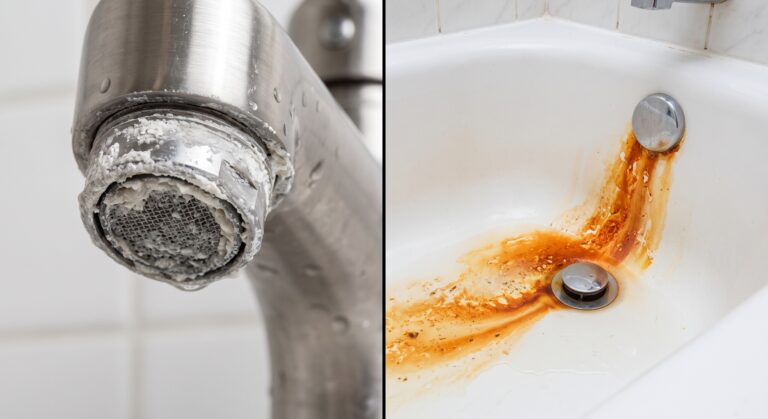
White scale around a faucet and orange stains in a sink can both look like “bad water,” but they usually point to different problems. For homeowners in Honey Brook, Coatesville, Downingtown, Glenmoore, Parkesburg, Morgantown, and other Chester County communities, that difference matters. Choosing treatment before you know what is in the water can mean paying for equipment that does not solve the actual issue.
Hardness is mainly caused by dissolved calcium and magnesium. Iron is a separate mineral that can create orange-brown staining, sediment, and a metallic taste. A private well can contain one, the other, or both. The most reliable way to choose a treatment system is to recognize the clues, test the water, and match the equipment to the results.
Hard Water and Iron Are Different Water Quality Problems
Hard water is usually a nuisance rather than a drinking-water health concern. The U.S. Geological Survey defines water hardness by the amount of dissolved calcium and magnesium in the water. As those minerals dry on surfaces or are heated, they can leave scale behind. That is why hard water often shows up as white or gray crust on faucets, cloudy glassware, soap residue, and mineral buildup in water-heating equipment.
Iron behaves differently. Penn State Extension notes that iron in private water systems can cause orange-brown stains, particles, and a metallic taste. In some wells, water may look clear when it first comes from the faucet, then develop rust-colored staining or particles after it has been exposed to air.
These problems can overlap. A home can have hard water and iron at the same time, especially when it relies on groundwater. That is one reason symptoms alone are useful for narrowing the possibilities, but not for selecting treatment equipment.
7 Clues That Help Separate Hard Water From Iron
1. White or Gray Crust Usually Points to Hardness
Look closely at faucet aerators, showerheads, glass shower doors, coffee makers, and other places where water regularly evaporates. Chalky white or gray deposits are classic signs of hardness minerals. If you clean the buildup and it returns quickly, hardness should be on the list of things to test.
2. Orange or Rust-Brown Stains Suggest Iron
Orange-brown rings in toilets, rusty streaks in sinks, stains on tubs, or reddish marks on laundry are more consistent with iron than simple hardness. Iron can also leave sediment behind. If the staining is dark brown or black, manganese may be involved as well, so testing should include both minerals.
3. Poor Soap Lather Favors Hard Water
If shampoo, hand soap, or laundry detergent seems harder to lather, hardness may be part of the problem. Calcium and magnesium react with soap, which can leave residue and make cleaning feel less effective. Homeowners may notice that they use more soap or detergent than expected while still seeing film on fixtures and dishes.
4. A Metallic Taste Is More Consistent With Iron or Manganese
Hard water can affect how water feels and how fixtures look, but a noticeable metallic taste is a stronger reason to test for iron and manganese. Taste alone cannot tell you the exact concentration or form of the mineral, so avoid choosing a filter based only on what the water tastes like.
5. Cloudy Glassware Often Points to Hardness
If glasses and dishes come out of the dishwasher spotted or hazy, hardness minerals may be drying onto the surface. A persistent film that returns after cleaning is different from the orange-brown staining that usually makes iron easier to recognize.
6. Water That Changes Color After Sitting Can Point to Dissolved Iron
Some forms of iron are dissolved in groundwater and are not obvious immediately. Penn State Extension explains that water with dissolved iron can appear clear at first, then form orange-brown particles as the iron reacts with oxygen. That change after standing is a useful clue to mention when you schedule water testing or service.
7. Water Heater Scale Is a Strong Hardness Clue
Hardness becomes especially noticeable where water is heated. Scale can collect inside water heaters and on heating surfaces, which can reduce heat transfer and contribute to equipment problems over time. If you are seeing repeated scale along with hot-water performance issues, it is worth checking both the water quality and the condition of the plumbing equipment.
Why Testing Comes Before Treatment
A water softener is designed primarily to reduce calcium and magnesium hardness. That does not mean every orange stain or metallic taste should be treated with a softener. Penn State notes that conventional softeners can remove certain amounts and forms of dissolved iron under the right water conditions, but other iron or manganese problems may require oxidation and filtration instead.
The practical takeaway is simple: do not buy treatment equipment based on color, taste, or a sales pitch alone. Testing tells you how much hardness, iron, and manganese are present and gives a professional the information needed to size and select the system properly.
For private wells, the Pennsylvania Department of Environmental Protection recommends annual testing for total coliform bacteria, nitrates, total dissolved solids, and pH. If you are seeing orange-brown stains, black specks, metallic taste, white scale, unusual odors, or other changes, add testing for the suspected water-quality issue. Use a state-certified drinking-water laboratory for testing.
Barber Plumbing & Heating can help homeowners interpret water-quality results and plan a treatment approach through its water conditioning services. The company also handles well pump installation and repair, which is useful when a water-quality concern is happening alongside low pressure, pump cycling, sediment, or another well-system symptom.
What Treatment May Look Like After You Have the Results
If hardness is the main problem, a properly sized water softener may be the most direct solution. Softening targets calcium and magnesium so there is less scale on fixtures, less mineral buildup in water-using equipment, and better soap performance. Homeowners who want a deeper overview of hardness symptoms can also review Barber’s existing guide to hard water in Chester County.
If iron or manganese is the main issue, treatment depends on the concentration, the form of the mineral, the pH of the water, and the presence of other water-quality problems. Some low-level dissolved iron can sometimes be handled by the right softening system. Higher concentrations or oxidized iron may call for dedicated filtration or an oxidation-and-filtration approach. The correct system should be chosen from test results, not from a one-size-fits-all rule.
If the water problem has already contributed to clogged aerators, damaged valves, reduced fixture flow, or trouble with a water heater, water treatment may need to be paired with plumbing repair. Treating the source helps prevent repeated buildup, while repairing affected components restores the system you already have.
When Chester County Homeowners Should Schedule Water Conditioning Help
Schedule professional help when scale keeps returning, orange or black staining is spreading, a metallic taste persists, or you are unsure which treatment system matches your test results. It is also a good time to call if you recently moved into a home with a private well and do not know the system’s treatment history.
Barber Plumbing & Heating is based in Honey Brook and serves homeowners throughout southwestern Chester County and nearby communities. As Chester County Board of Health certified well pump installers, the team can help connect well-system performance, water testing, and treatment decisions instead of treating each symptom in isolation.
If your faucets are crusted with white scale, your sinks are turning orange, or your well water simply does not seem right, start with testing rather than guessing. Call Barber Plumbing & Heating at (610) 273-2369 to discuss your water results and the right conditioning system for your home.
Struggling with hard water, staining, or uncertain well water quality? Let the Chester County Board of Health-certified experts at Barber Plumbing & Heating help. Call 610-273-2369 today for professional water conditioning and well-system evaluations.
Frequently Asked Questions
Can hard water and iron occur in the same well?
Yes. A private well can contain hardness minerals and iron at the same time. Testing is the best way to determine the concentration of each and whether one treatment system can address both problems.
Does orange staining mean my water is hard?
Not necessarily. Orange or rust-brown staining is more commonly associated with iron. Hardness is more likely to leave white or gray scale. Because multiple minerals can occur together, a water test is still the right next step.
Will a water softener remove iron from well water?
Sometimes, but not in every situation. Certain softeners can handle limited amounts of dissolved iron when the water chemistry is appropriate. Other iron problems require different filtration or oxidation equipment. Test the water before choosing a system.
What should I test for if my well water is staining fixtures?
For orange-brown staining, test for iron and consider manganese as well. For black staining or specks, manganese should be included. For white or gray scale, test hardness. Private-well owners should also keep up with routine annual testing recommended by Pennsylvania DEP.