

Last Updated: November 7, 2026
Quick Summary
Upgrading to a tankless water heater delivers hot water on demand, lower standby heat loss, and reclaimed floor space, since it heats water only when a tap opens instead of keeping 40 or 50 gallons hot all day. Tankless models are typically 24% to 34% more energy efficient than tank models for households with moderate hot-water use.
- A 2026 comparison found tankless units typically 24% to 34% more energy efficient than tank models.
- A 2026 savings guide estimates annual household savings of $100 to $180 after switching to tankless.
- Size a unit by peak fixture flow rate in GPM at your coldest incoming water temperature.
- Gas retrofits usually need a larger gas line and stainless steel venting; electric swaps often need heavier wiring.
- Tankless units require annual descaling, especially in hard-water areas, to protect the heat exchanger.
Table of Contents
- Benefits of Upgrading to a Tankless Water Heater
- Tankless Water Heater Pros and Cons
- Benefits of Tankless Water Heater vs Tank: Energy and Space
- Cost of Tankless Water Heater vs Traditional: Upfront and Long-Term
- Sizing a Tankless Unit to Your Household Flow Rate
- Retrofit Feasibility: Fuel Type, Venting, and Capacity
- Maintenance and Ownership Costs Nobody Mentions
- Is a Tankless Upgrade Right for Your Chester County Home?
- Frequently Asked Questions
Benefits of Upgrading to a Tankless Water Heater
The benefits of upgrading to a tankless water heater come down to three things: hot water on demand, lower standby losses, and floor space you get back. A tankless water heater heats water only when a tap opens, so it isn’t keeping 40 or 50 gallons hot all day. The households that come out ahead are the ones who plan the retrofit before they buy the box. Our water heater repair and replacement service can help you decide whether to repair your current unit or upgrade to tankless.
Consumer Reports has tested tankless units against storage-tank models to see whether they perform and save energy as advertised, and the short answer is that results depend heavily on the household (Consumer Reports tankless vs. storage tank comparison). That’s the honest framing. Below, we’ll walk through the real benefits, the real costs, and how to tell whether your home is a good fit.
On-Demand Hot Water Instead of a Tank on Standby
A tankless unit is exactly what the name says: water flows through a heat exchanger, gets heated, and goes to the tap. No tank sits in the basement slowly losing heat. A 2026 comparison of tankless and traditional units found tankless models are typically 24% to 34% more energy efficient than tank models, though that figure applies to households with moderate hot-water use (DSC Water tankless vs. traditional comparison). Heavy simultaneous demand changes the math.
Tankless Water Heater Pros and Cons
The tankless water heater pros and cons are straightforward once you strip out the marketing. On the plus side: continuous hot water, no standby heat loss, a compact wall-mounted unit, and a longer service life when it’s maintained. On the minus side: a higher upfront cost, a retrofit that may require gas-line or venting work, and a flow limit you’ll notice if three showers run at once.
A. O. Smith frames these benefits as trade-offs against higher upfront cost rather than a free win (A. O. Smith tankless pros and cons). That’s the right way to look at it.
| Factor | Tankless | Storage Tank |
|---|---|---|
| Hot water supply | Continuous | Limited to tank size |
| Standby heat loss | Minimal | Constant |
| Footprint | Wall-mounted, compact | Floor-standing tank |
| Upfront cost | Higher | Lower |
| Flow limit | Yes, per unit | Yes, per tank |
| Maintenance | Annual descaling | Occasional flush |
Benefits of Tankless Water Heater vs Tank: Energy and Space
The benefits of tankless water heater vs tank come down to where the energy goes. A storage tank reheats water around the clock whether you’re home or not. A tankless unit spends energy only during a draw. That’s the efficiency story, and it’s real, but it’s also smaller than the sales pitch suggests for a household that already uses hot water sparingly.
Space is the underrated benefit. A tankless unit hangs on a wall and frees up the corner of a basement or utility closet. If you’re finishing a basement or reclaiming storage space, that square footage has value beyond the energy bill.
Standby Heat Loss and What It Costs You
Standby heat loss is the energy a tank uses to keep stored water hot between draws. It never stops. A 2026 savings guide estimates annual household savings of $100 to $180 after switching from a tank to a tankless model, though the source doesn’t document its methodology (Cool Wichita tankless savings guide). Treat that as a ballpark, not a promise. Your actual savings depend on how much hot water you use and what you pay for fuel.
Cost of Tankless Water Heater vs Traditional: Upfront and Long-Term
The cost of tankless water heater vs traditional splits into two piles: what you pay on day one and what you pay over the life of the unit. Day one is higher for tankless, but the gap depends on the retrofit, not just the box. The installed cost is the unit plus labor plus whatever the home needs to support it: gas-line upsizing, stainless steel venting, a dedicated electrical circuit, or a condensate line for a condensing model. A straightforward swap in a home with the right infrastructure costs less than a retrofit that needs a new gas line and venting.
Long-term, the operating cost is usually lower because you’re not heating a standing tank. The payback math has three inputs: your fuel type and utility rate, how much hot water you actually use, and the installed cost. A household that uses hot water in short, spread-out draws captures more of the standby savings than a household that runs long, simultaneous draws. Any single payback number is a guess unless it’s built on your rates and usage, so treat headline figures as ballpark only.
A practical way to frame it: compare the tankless installed cost against a replacement tank of similar capacity, then estimate annual operating savings from your own utility bills rather than a generic percentage. If the upfront number is the sticking point, financing options can spread the project across monthly payments. We’d rather you see the whole picture than a headline price that ignores the install.
Watch out: a low quoted price that excludes venting, gas-line work, or electrical upgrades is the most common way homeowners get surprised mid-project. Ask for an itemized estimate that lists each of those line items separately.
Sizing a Tankless Unit to Your Household Flow Rate
Sizing is where most tankless regrets start, and it’s the step competitors gloss over. A tankless unit is rated by flow rate in gallons per minute (GPM) and by the temperature rise it can deliver at that flow. The unit can only heat so much water at once, so the right size depends on two numbers: how many fixtures you might run together, and how cold the incoming water is.
Start by adding up the fixtures you’d realistically run at the same time. Add up the flow rates of the fixtures you would run together; that total is your peak demand, and the unit must be rated to deliver it at your incoming water temperature.
Temperature rise is the second half of the math. A unit rated for 5 GPM at a 70°F rise can’t deliver 5 GPM at a 90°F rise. Incoming water in colder months is colder, so the same fixture load demands more from the unit in January than in July. Most manufacturers publish a flow-versus-temperature-rise chart; read it at your coldest expected incoming temperature, not the average.
A common mistake is buying on tank-size logic. A 50-gallon tank and a tankless unit aren’t measured the same way, and a unit sized for one shower will disappoint when two run at once. If your peak demand exceeds a single unit’s rating, the options are a larger unit, a condensing model with a higher capacity, or two units plumbed in series. Watch out: oversizing to avoid the problem can trigger minimum-activation issues and short-cycling, so size to the real peak, not the theoretical maximum.
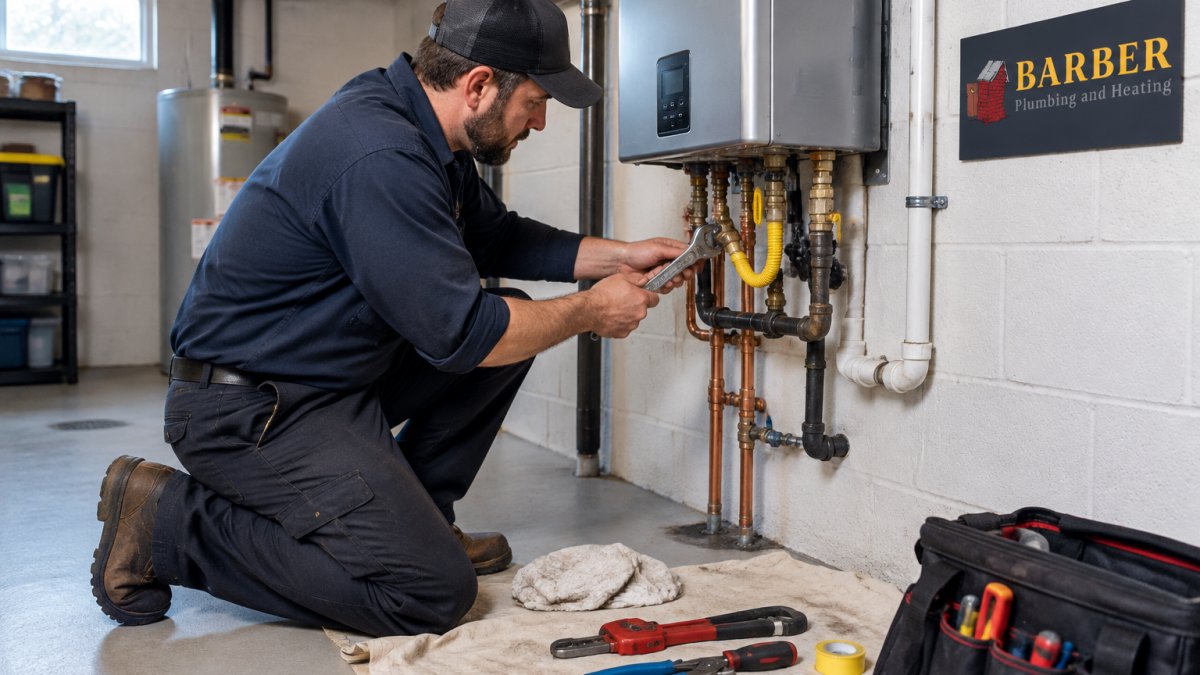
This is also where a professional walkthrough pays for itself. Our team handles water heater installation and can measure your actual incoming temperature and fixture load before you buy, so the unit on the wall matches the household behind it.
Retrofit Feasibility: Fuel Type, Venting, and Capacity
Retrofit feasibility hinges on three things: fuel type, venting, and capacity. A gas water heater replacement with tankless usually needs a larger gas line and stainless steel venting, because tankless units pull more BTUs at once. An electric water heater swap often needs heavier wiring and a dedicated circuit. Propane works too, with its own supply considerations.
This is the step where a professional walkthrough saves money. Our team handles water heater installation and can tell you before you buy whether your gas line, venting, and panel can support the unit. Watch out: skipping this step is how homeowners end up paying for a second round of work after the unit is already on the wall.
Maintenance and Ownership Costs Nobody Mentions
Tankless units need annual descaling, especially in areas with hard water. Mineral buildup coats the heat exchanger and cuts efficiency, and in a hard-water home that buildup happens faster. A tank needs an occasional flush; a tankless unit needs a consistent schedule, and skipping it shortens the lifespan you paid a premium for.
If your water is hard, water conditioning protects the unit and keeps performance steady. Budget for the annual service the same way you’d budget for an HVAC tune-up. It’s not glamorous, but it’s the difference between a 20-year unit and a 10-year one.
Is a Tankless Upgrade Right for Your Chester County Home?
The right call depends on your household, not the brochure. Tankless makes sense if you have moderate, spread-out hot-water use, space to reclaim, and a home that can support the retrofit without major rework. It makes less sense if you routinely run multiple showers at once or your electrical panel is already maxed out.
If your current water heater is failing, don’t wait for it to quit on a holiday weekend. Contact our team for an honest assessment of repair versus replacement, and we will help you determine whether tankless fits your home.
A tankless upgrade rewards planning more than enthusiasm. If you’re weighing the switch, start with a professional assessment of your fuel type, venting, and flow needs. Barber Plumbing & Heating is a multi-generational family-owned business with over 75 years of combined experience, and we offer 24/7 emergency service and certified Chester County Board of Health pump installation. Get started with Barber Plumbing & Heating and make the upgrade with confidence instead of guesswork.
Frequently Asked Questions
Is it worth switching to a tankless water heater?
It depends on how much hot water your household uses and how long you plan to stay. If you rarely use hot water or plan to move soon, the higher upfront cost of a tankless water heater may not pay back before you sell.
What are the negatives to a tankless water heater?
The main drawbacks are upfront cost, retrofit work, and cold-water delay. Tankless units cost more to buy and install, and a gas model may need a larger gas line or new venting. There is also a short delay before hot water reaches the tap, and the unit needs a minimum flow rate to activate. Hard water requires periodic descaling to prevent mineral buildup, which adds an ownership cost a storage tank does not have.
How much money will I save by switching to a tankless water heater?
Actual savings depend on your incoming water temperature, how much hot water you use, and your fuel type. Households with moderate hot-water use see the efficiency gain most clearly, while low-use households may save less because standby heat loss was already small.
How long do tankless water heaters last?
Tankless units generally outlast storage-tank models because there is no tank to rust through. The trade-off is that longevity depends on maintenance: in hard-water areas, mineral buildup inside the heat exchanger shortens life unless the unit is descaled on schedule. Ask about your water hardness before you buy, and factor annual descaling into your ownership costs when comparing a tankless water heater against a traditional tank.